 |
| The grateful seated |
Thankfully, we did have the foresight to book our hotels and trains long in advance and when we rocked up to the shinkansen station in the morning, it was pretty clear that was a good move. Throughout the day, people were spilling out of the standing-room-only unreserved seating cars and peering jealousy into ours, where we sat in relative luxury. The first bit of the trip was the longest - we left Kobe just past ten and didn't arrive in Nagasaki until mid-afternoon. We stopped at Hakata on the way, where we discovered that a 20 minute transfer isn't nearly as relaxed as it looks on paper. Lisa got stuck waiting for the loo with half the women of Japan while I elbowed people out of the way to get the last couple of lunchboxes available in the bento shop - fortunately we managed to get up to the platform fully supplied by the time the train showed up.
 |
| The only way to travel |
When I booked the tickets, I was upset that we weren't able to use the new shinkansen but this evaporated as we saw what had just pulled up. We boarded through a big curvy hallway between the carriages, complete with viewing windows and wooden floors - it looked more like an airport terminal than a train. We shuffled into the carriage and plopped down into our leather chairs - it was like sitting in an upmarket cinema. It seemed entirely too large a train for the route and probably was - it lurched and rocked its way along a boneshaker of a country track, pitching its way around corners at almost 45 degrees. Still, the scenery was lovely as we got further and further into Kyushu - old abandoned weatherboards, swimming beaches and boats sinking into the mud as the tide went out dominated most of the landscape.
 |
| Where everybody knows your name |
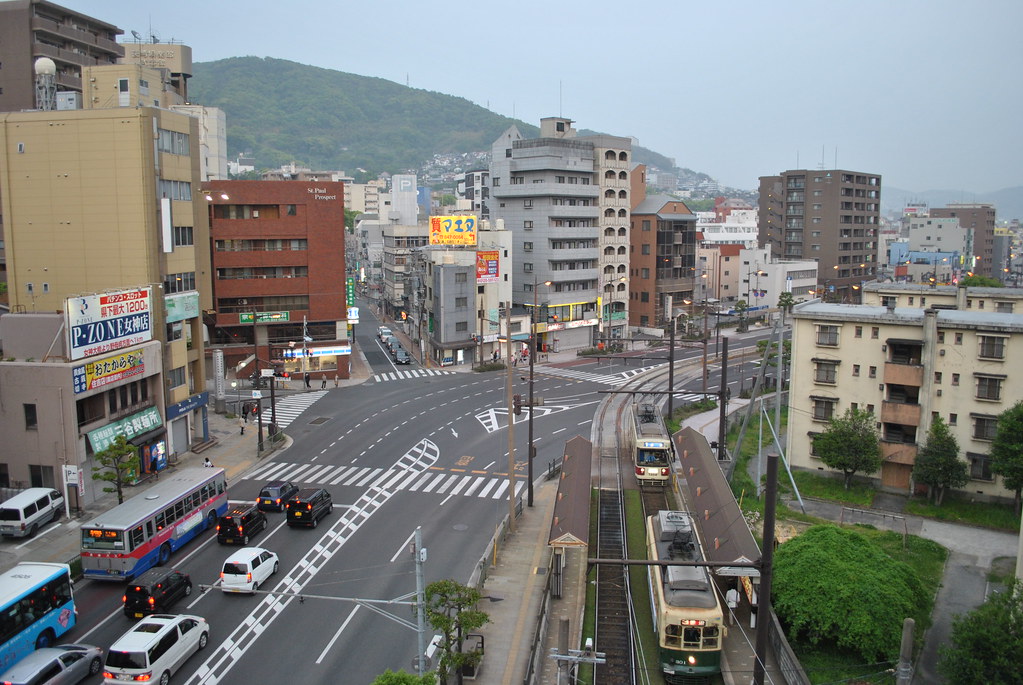
After a very long trip, we emerged at Nagasaki station, which looks like a little country stop that hasn't realised it has a big city attached to it. Thankfully our hotel was right in the centre of the city so we didn't even need to hop a tram to get there - we checked in, dumped our stuff and headed straight back out into the thick of it. There had been some unsuccessful last minute attempts to book a boat trip to "Gunkan jima" (Battleship Island) so we wandered over to the port to have one last try in person, but the best the cruise company could do was to tell us to come back in the morning and put our name down on the cancellation list. In the meantime, we stopped in at Dejima, an extremely strange little trading post that used to be where the Dutch merchants did business.
 |
| The fanciest place in feudal Japan |
Dejima is an artificial island that was originally surrounded by a "moat" of seawater, but the city has since been built up around it which makes it seem even more out of place. It's a weird mix of Dutch and Japanese architecture; Japanese buildings surrounded by decorative balconies and tatami mats with full dining settings on top of them. Nagasaki was the only part of the country that always stayed open to the rest of the world but even then, it was barricaded off from the rest of the port and noone was allowed to leave. Apparently people would come there not only to do business but also to learn more about what was happening in the outside world. It's a weird place - to the amusement of the Japanese, the settlers made it more like home by painting sliding screen paper and using it as wallpaper, which probably made it even more intriguing for visitors.
 |
| As intense as it gets |
After that, we walked down to Nagasaki Chinatown, which is as colourful and noisy as Chinatown is anywhere. We had a snack there and wandered along the streets with the crowds, emerging out the other side to a little spot called "Spectacles Bridge". It's so called because its reflection in the river makes it look like a pair of glasses, which seems to be extremely exciting if you're from Nagasaki. I started to get the uneasy sense that this was the Perth of Japan. We walked back up to the hotel and asked the concierge for a recommendation for dinner, which turned out to be the boardwalk at the port. Our big circle of the city was complete.
 |
| Not too sure about this |
We made it back to the port and settled in for a drink before dinner, managing to find ourselves a little possy outside in the breeze. It's not particularly common to be able to sit outside in Japan, so we were happy to be able to people and boat watch for a change. We ordered a couple of beers and then spotted "smoked horse meat" on the menu - it looked and tasted like very nice pastrami. We sat for a while with the bobbing boats and watched the sun sink over the horizon, then settled up and wandered to the "Red Lantern", our dinner spot.
 |
| Whiskey business |
We ordered up some Nagasaki champon, which is basically a big bowl of noodles in soup with meat, vegetables, seafood and anything else you can get away with throwing in. It's probably the least appealing food I can think of to look at, with ugly pale greens and pinks in milky soup, but this was a really good example - lovely, rich and fresh. We washed it down with a sampler of Chinese whiskey, which got nicer with each sip. Once we had finished, we took a walk around the wharf, found a shopping centre basement that stayed open until ten and poked around the souvenir displays until it was time to head back for bed.
 |
| Shape up or ship out |
The next morning we got started early, having been told to get to the cruise company office for 8am. We had breakfast at the hotel and zoomed out to the port again, finding to our horror that we seemed to be about 20th on the list of people waiting for cancellations. We wrote our names and phone numbers down but it wasn't looking good - the ship finally left at 9 and we weren't on it. Thankfully, a couple of very stubborn Japanese ladies took me under their wing and resolutely formed a queue to be put on the waiting list for the afternoon cruise. We stood there for about 20 minutes before we finally got a result - someone had called in cancelling their booking; we were confirmed for the afternoon. Buoyed with our success, we headed out to the other end of the city toward the peace park and atomic bomb museum.
 |
| How I learned to stop worrying |
The museum in Nagasaki isn't nearly as in-your-face as its equivalent in Hiroshima - it's mostly just a recounting of the facts and figures as well as symbols of the bombing - stopped clocks, letters from the victims and bits and pieces about nuclear disarmament. In a lot of ways I prefer it - you can get the message across without burned school uniforms and photos of skeletons.
 |
| Rest in peace |
The peace memorial was particularly poignant - its centrepiece is two glass pillars facing toward the hypocentre with the names of all the victims inside. Above it is a round spring of water with 70000 tiny LED lights along the bottom - one for each victim. A plaque nearby says that this is the water that they all desperately wanted after the explosion.
 |
| Not even he knows what he's doing |
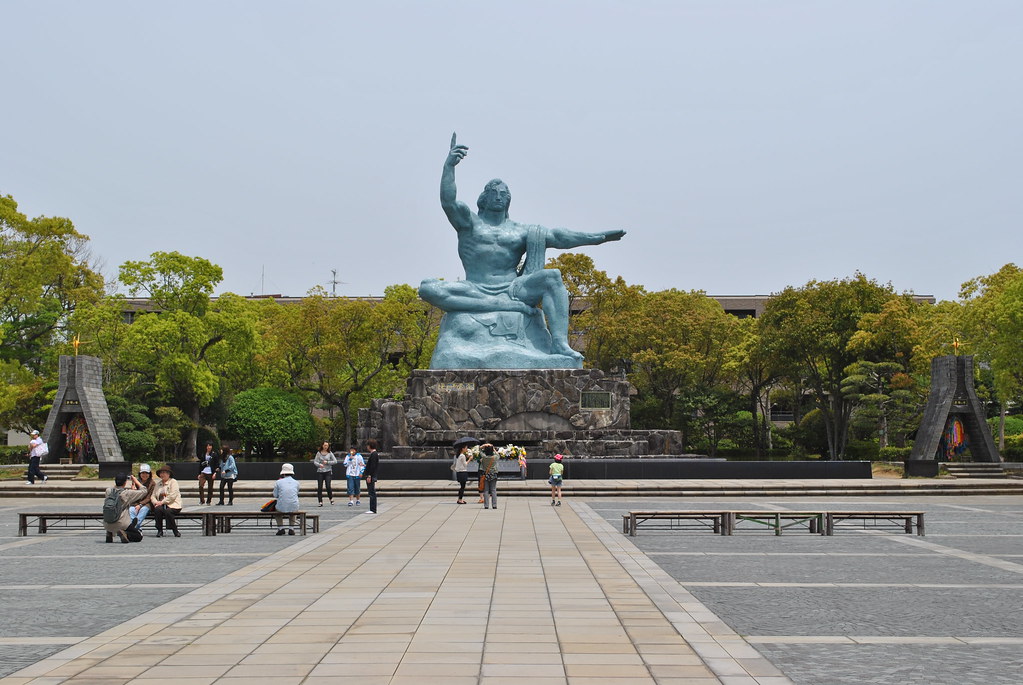
Like the Hiroshima Atomic Bomb Dome, Nagasaki has a few structures that were left standing after the explosion. Near the blast site, half a torii gate was blown away, but the other half stands resolutely to this day, which I imagine some people think of as a bit of a miracle. One section of the wall of a cathedral also stands despite being right near the hypocentre, which is marked with a black pillar and surrounded by monuments. We continued walking down to the memorial park, where there were dozens of statues donated by different countries. A big fountain designed to look like the wings of peace stands at one end, while at the other an oddly proportioned statue sits in an odd pose that's supposed to convey all kinds of messages about nuclear war.
 |
| Don't even think about it |
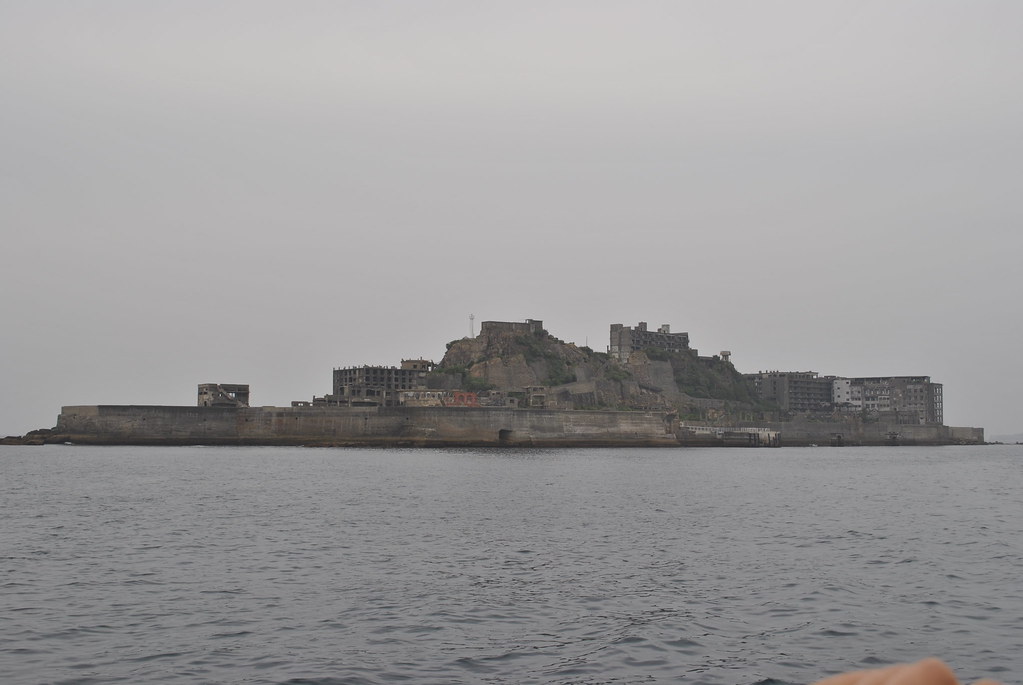
By this stage it was time to head back to the port, grab some lunch and hop on our hard-won ferry to Battleship Island. It used to be used as a mining colony fully set up with accommodation, schools and workshops but now it's absolutely derelict. We pulled up to the side of it, feeling very much like we were heading on to a film set and listened to the guides explain what each grey wreck used to be. You're only allowed on a very small part of the island and I can see why - leaving the walkways and going into the buildings would probably result in a "rocks fall, everyone dies" scenario pretty quickly.
 |
| Man the guns |
Gunkan jima still managed to look forboding even in the old photos when people lived there - I think it was only a matter of time until it crumbled away. We didn't get a proper idea of the "battleship" part until we had pulled far enough away - from a distance, it looks like a big destroyer. Given the number of people swarming out there to see it, I'm wondering if it makes more money now than ever.
 |
| Jaw... unhinged |
We headed back for our second and last night in Nagasaki, having dinner at the station after we finally located the other thing I "had" to eat while I was there - a Sasebo burger. This is unashamedly just a colossal American-style burger, made popular by a town called Sasebo not far away. It's "famous" in the area though, which makes wanting to eat one an entirely legitimate cultural experience. Apparently what's actually on it depends on the maker, but this one was a double bacon and egg burger with special sauce and onion rings. Apparently Nagasaki's other unlikely claim to dining fame is called "Toruko rice" (Turkish rice), which is pilaf served with an omelette, schnitzel and sometimes a big sausage as well. This is the kind of traditional Japanese food I could get used to.
 |
| The Sydney to Nagasaki's Perth |
We hopped back on our ballroom-on-wheels early the next morning and had a relatively short trip back up to Hiroshima, which is probably what Nagasaki would be like if Nagasaki weren't in the middle of nowhere. They both have trams but Hiroshima's feel less like little street trolleys and more like trains that decided the roads were more to their liking. This time our hotel was sodding miles away, so we had to hop on a bus and wind our way through the grand streets all the way out to Hiroshima port. The hotel was quite unlike anything I've booked before - I'm quite sure if the backpacking me of 8 years ago saw it, he would retreat hissing to the nearest YMCA like a crucifix-spooked vampire. Times have changed though, and I'm now slightly less cheap than I used to be; we ended up in the grandest foyer I've been into in a long while and I was somewhat confused when the porter asked if I needed my bag carried. We seemed to have been upgraded and ended up with a safe, a huge bed with a long body pillow and a set of about 20 Egyptian face products which Lisa tried all of.
 |
| Hihairious |
Not wanting to lose any time, we nipped straight downstairs and found out that there was a high speed ferry across to Miyajima that left directly from the hotel. We didn't truly appreciate how amazing this was until we were forced to go home the long way later - it took about 2 hours. On the way there though, we roared along on the top deck, hair blowing around hilariously and smiles etched on our faces - it took about 15 minutes door to door. We hopped off and started trawling through endless souvenir shops, watched as the local deer population ate every piece of paper they could find (including ferry tickets, signs warned) and gradually made our way towards the floating shrine gate.
 |
| Is it still there? |
The tide had completely gone out by the time we arrived, so we were able to walk through the shrine on the beachside and hop off down to the shoreline to get a look close-up. When the tide is in it looks like the gate is floating on the surface of the water (which it kind of is, apparently) but when everything is dry you can see its barnacley legs, jammed full of coins that people have put there for good luck.
 |
| Beer o'clock |
Once we had taken enough photos, we had a break with some "Miyajima beer", locally brewed pale ale made by a guy who seemed much more interested in setting up his barbeque than bartending. We ended up staying for two, sitting at our little plastic table with some wasabi snacks and watching people hurrying back towards the ferry. Eventually the sun started to drop and after a bit of souvenir shopping, we had some Hiroshima-yaki (like okonomiyaki but with noodles sandwiched in the middle) and wandered back up to the floating shrine.
 |
| Take 32 |
By this stage it really was floating, looking awfully nice with its reflection waving in the water, so we took some more photos which everybody seemed intent on ruining. We stood awkwardly posed in front of the shrine gate with our camera timer beeping at maximum volume, and obviously missing these cues, some guy walked into the shot and filmed us standing there with his camcorder. The result was a photo of him completely blocking the shrine and probably some director's commentary over the top of his holiday video saying nice job ruining my photo, peenarse. Eventually we got the shot we wanted unmolested and wandered back past the deer who were by this stage polishing off the last of their paper bags and going to sleep. Amusingly, the JR ferry had a ramp at the front that reminded me of Saving Private Ryan, so I couldn't help imagining myself storming Omaha Beach in slow motion as I got off.
 |
| I'LL GIVE YOU SOMETHING TO CRY ABOUT |
And suddenly it was the last day of our holidays - we checked out of the hotel and headed into the city for the last few hours of our trip. We stowed our luggage at the station and headed to the Peace Park and Museum, which ranged from subtle, sad displays to hammer-to-the-face dummies of children with melting skin. It's all very professionally appointed but I think they could probably dial it down a little without losing too much of the message. Judging by the number of screaming children, I doubt I'm the only one who felt that way.
 |
| Needs a lick of paint |
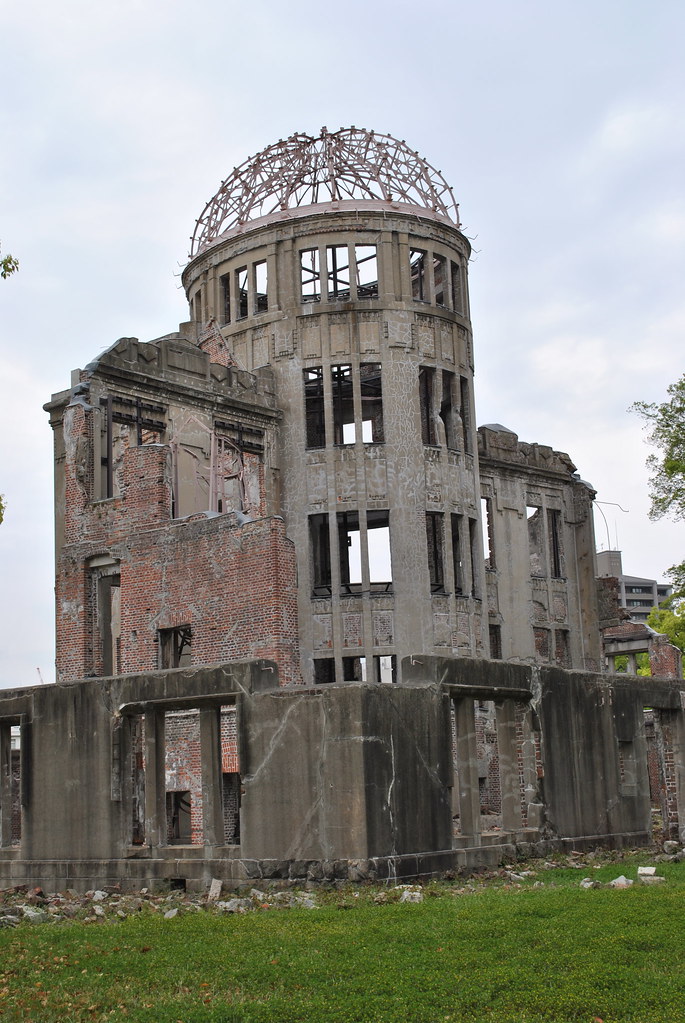
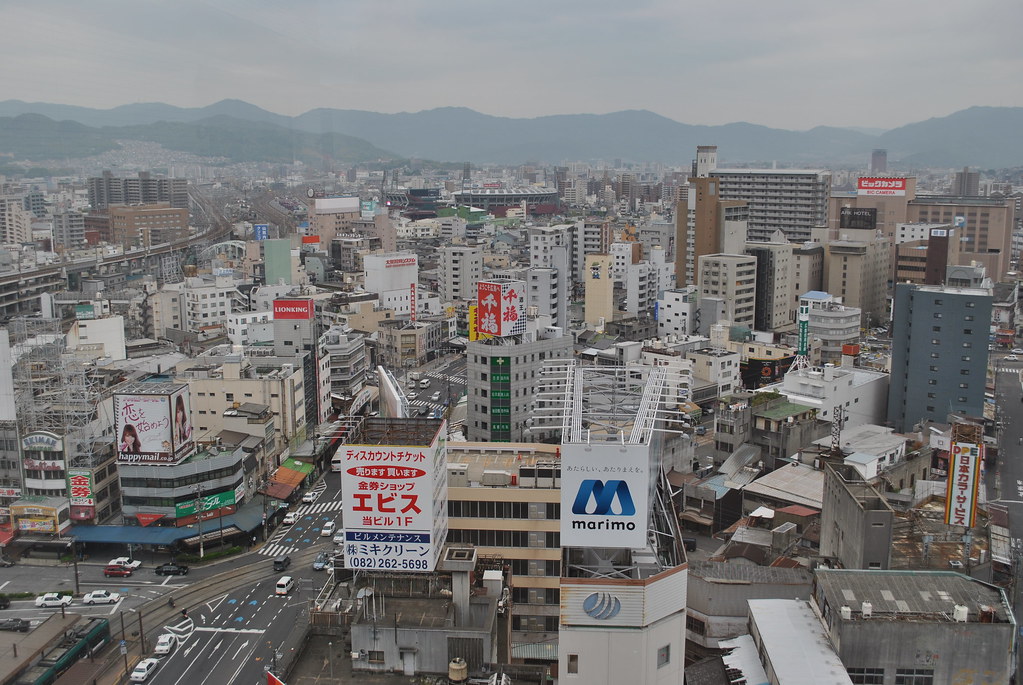
We continued out the other side and had a wander around the Peace Park and Atomic Bomb Dome, which stands as a twisted and burned out reminder of how destructive the explosion was. By this stage I think we were a bit fed up with it though, so we did a quick lap and then headed back to the city centre for a poke around the shops.
 |
| I want MY drab city back |
By the end, I think we were well and truly ready to go home, having exhausted all possibilities. I had about 60 yen at this stage, having spent the last of my money on a very strange haircut. This is perhaps a testament to how out of ideas we were - we couldn't physically fit any more food or coffee into us, so the only solution for burning the last of our holiday hours was to do weekend chores. Grateful for a chance to sit down again, I paid my 10 bucks and had a woman chop away at my hair, periodically stopping to consult a picture of a boyband-looking magazine man for inspiration. Fortunately I didn't end up looking like him, but once she seemed satisfied with her work, she pulled out a big hose and vacuumed my head. It was like being sniffed by a very hungry elephant. 5 o'clock eventually came and we exhaustedly dropped into the shinkansen home. People say it's best to leave a holiday feeling like you want more but I disagree - there's nothing nicer than coming home absolutely shattered to your own bed, your own couch and your own non-junk food. All up it was a lovely trip away and it achieved exactly what a holiday should - making you feel like work would be a nice change. We'll see how long that lasts.

No comments:
Post a Comment
Comment away, I'd love to hear from you! Try not to swear etc. though - my mum is probably reading this.